
So, I heard an interesting comment about 1984 from a brother-in-law of mine. He said that after reading the book, the impression he had was that it was a horror novel. I thought that was very interesting, and quite a compelling idea. The point about a horror story is that there is no triumph over the enemy in the end. We love stories where the good guy wins, but in true horror stories the only one left in the end is the bad guy. So with this novel; there is no triumph. The establishment wins, and our "hero" is turned. We are left without hope ("hope lies with the poles"). The enemy has total control. In the end it would seem that even the mysterious "Brotherhood" was a figment of the government to further manipulate the minds of party members. It certainly seemed to work. It was his hope of joining the opposition that prompted him to expose himself so fully to his enemies.
The book is certainly an interesting thought experiment into politics and political evolution. The thing that I think is overlooked which would be a great barrier to such a governmental structure taking full root is the reality of religion. I don't think the type of situation described in the book could be achieved in reality because of religion. No government that has either banned or usurped religion has ever lasted.
I thought an interesting part of the book was the manipulation of language. They were not only trying to change peoples' image of history and reality, but their very ability to express themselves. I think language can have a very real effect on the way people think. If there is no word or expression for a concept, you are unlikely to conceptualize it. A person's language moulds the way they think. It most certainly influences the things they express. Some things just can't be said in certain languages. This was very well utilized in the novel.
I must agree with some of the other comments about the time jump at the end of the book. It was rather startling. I must admit that I was holding out for some sort of saving moment (human nature?) and found myself disappointed that he gave in and became a nobody in the end.
Kevin, I will have to add "We" and "A Brave New World" to my list of books to read. I should be starting on "Fountainhead" soon.
Well, this was jumping around a bit, but I wanted to throw out a few ideas and keep the discussion going. Micaela should be finishing the book soon and I am interested in hearing her comments.
Friday, September 5, 2008

Tuesday, August 12, 2008
Progress and Setbacks
I am making slow, but steady progress in my recovery. The tonsillectomy has by far been the most difficult to recover from, but I am now just at something like a bad sore throat. My fever continues to fluctuate, and I still require quite a bit of water, but I can eat anything I want. I had some small delays in starting the new book, "1984," due to illness and travelling (I haven't actually read or listened to any books so far during my recovery because I have just been zoning out so badly.), but I am starting today and should keep up a fair pace of it.
In starting reading, I find it interesting to note that George Orwell's novel was written around the same time that Ayn Rand was herself writing. Their themes are similar, a totally overreaching government system that seeks to control every aspect of civilisation and culture. The difference is that Ayn Rand, having grown up during the communist revolution put it as the enemy of freedom, whereas George Orwell, writing from a western perspective has imagined that such oppression would likely come by way of a totalitarian dictatorship. We see by their parallel works how similar both of these philosophies can be.
Now, let us read on and enlighten our minds.
Thursday, August 7, 2008
Rotting Flesh and Intense Pain
I am pleased to announce that the Red Raccoon Book Club will next be reading "1984," by George Orwell (aka Eric Arthur Blair), published 1949. You are all welcome to join in.  This was a particular request of Kevin, for whom it will hopefully be a distraction from life at sea. So, everybody, join in!
I have also just gotten "Fountainhead" from the library, so that will be coming up shortly as well.
This was a particular request of Kevin, for whom it will hopefully be a distraction from life at sea. So, everybody, join in!I have also just gotten "Fountainhead" from the library, so that will be coming up shortly as well.
Friday, August 1, 2008
Update...and Some Notes
 Well, I am pleased to see that our little book club is starting to get some recognition form outsiders. I hope this will continue and allow for much lively discussion of relevant topics. I did finish reading "Anthem," by Ayn Rand. This one was on cassette, and I was pleased to hear the correct Russian pronunciation of her name. The more I learn about her background, the more interesting her novels become because of the historical/cultural context in which they are placed. I would very much like to get my hands on her book "We the Living." However, I can't seem to find it on CD at my library. This is currently my preferred media.
 Back to "Anthem," though. I also really enjoyed this book. Is is quite short and is meant to be in the fantasy genre. She actually wrote it as a break from "Fountainhead." It is a fun little illustration about the corrupt nature of imposed socialism/communism. Also, as the name implies, it is an Anthem to the Ego, the individual soul of man, the unconquerable spirit of great men of all ages.
The great point of Ayn Rand's novels, as I see it, is to illustrate how seeking their self interest, men of great capacity will lift up all others around them. Also, that the proper place of government is only to punish behavior that threatens the physical safety of its citizens.
 It is an interesting and important fact of history that the Great American form of Government is set up in such a way as to prevent the speedy alteration of laws. Men are required to engage in lengthy debates, compromising and convincing their peers of the merits of their point of view. Our government is set up to check the proud man who thinks he knows best for all.
It is wonderful when a great man works for the benefit of those less capable. It is even more wonderful when that lesser man shows gratitude for the benefit he has received. However, if a government forces a man to work for the benefit of another the great man is suddenly punished for his capability, and the lesser man rewarded for his baseness. He is told that he is entitled to what he cannot produce himself and this removes the gratitude he ought to have felt. Instead, if any gratitude is expressed, it is to the government who wrongfully stole one man's goods for the benefit of another.
We must never feel entitled to anything if we are to be happy, for it is gratitude and achievement that brings happiness. Entitlement only brings sorrow, for we will always desire more and work for it less.
If great men are left free to work for their own benefit, they will always require the assistance of other men to reach their greatest ambitions. If these men are also allowed to be free to receive form their employers what they are worth then all will work to the best of their abilities and everyone will benefit. The greatest motivator in the world is for a man to be justly compensated for a job he enjoys doing. It is when we seek to withhold just compensation where it is due that we cease to be our brother's keeper. We must be wary of government programs that would force one man to work for the benefit of others and not for himself, because that will only breed laziness and resentment. Laziness on the part of the unjust recipient, and resentment on the part of the uncompensated producer. Such a system will never inspire hard work and growth.
It would seem to be clear from her novels that Ayn Rand is not a religious person. I would not state this as a fact, but I would like to respond to it with my own perspective on theology. Some may say that God is the greatest socialist there is, because He labors for all of us with no reward. What reward can be granted One who possesses all? To those of this opinion I would quote a simple scripture to which I often like to refer myself. It comes from the first chapter of the Book of Moses contained in "The Pearl of Great Price," as revealed in vision to the latter-day prophet Joseph Smith Jr. It reads thus:
"For behold, this is My work and My glory, to bring to pass the immortality and eternal life of man."
From this simple line it is elementary to see that the reward God gains for his labors is an increase in glory. There is no altruism here. I would submit that this is the reward gained by all parents who truly work for the benefit of their children. They gain their children's' gratitude and respect.
 Well, let me get away from opinion for a bit and continue with the promised update. I am still working my way through the book on General Washington.
I also read Bernard Cornwell's novel "The Last Kingdom." First in the series of which "Sword Song" is the fourth.

I have already read "Sword Song" and it is my great pleasure to make my way through the preceding three novels. I currently have "The Pale Horseman" and "Lords of the North" waiting on my shelf.

I really enjoy these books, but would not recommend them to squeamish women or children as they are about a true warrior. Lord Uhtred fights for good, but also for love of battle. Those men out there who miss the significance of the sword as a symbol of manhood will, I think, enjoy this series.
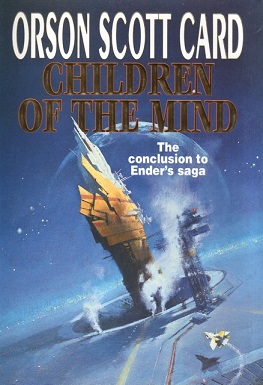 I also have on my shelf the recently obtained finale to Orson Scott Card's Ender Wiggin saga: "Children of the Mind." I am quite anxious to finish it off. The previous novel, "Xenocide," really broke of without satisfactory conclusion.
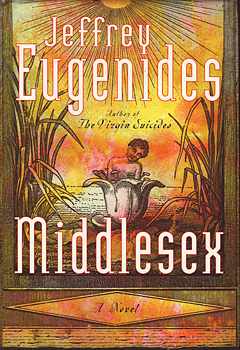
I totally forgot to mention another novel I recently finished by Jeffrey Eugenides entitled "Middlesex." This refers to a geographic location within the book, but also alludes to the fact that the novel is the story of a hermaphrodite. It is a very funny novel, and very well written spanning several generations of a Greek household ending in the story of Calliope (girl's name) later changed to Cal (boy's name), who is male, but due to a genetic defect resulting in female exterior sex organs, is raised as a girl until the onset of puberty causes all sorts of problems.
Some of you may find this believable autobiographical type novel amusing, however those sensitive to sexual issues may want to leave it alone. I believe this book was enjoyed equally as well by my lovely and talented wife.
Other books awaiting my reading:
"1984" by George Orwell
"Predator" by Patricia Cornwell
Monday, July 14, 2008
Selfishness
So, a few years ago Micaela bought a copy of Ayn Rand's defining novel "Atlas Shrugged." I was meaning to read it at that time, but never got around to it. It wasn't until last month when a friend of Micaela's was visiting who had started reading it for a book club. She mentioned that one of the issues in the beginning of the book is centered around oil in Colorado. Well, seeing as I now live in the Carbon Valley of Colorado, and there is a derek in the entry to our housing development, I thought I better get on with reading this book. I did, and I enjoyed it very much. I have since read more about the author herself, which has made it even more interesting. I have just started reading an earlier book of hers entitled "Anthem." Have any of you read her work? Please tell me your thoughts...especially if you understand the title of this blog.
Many, Many
I have been reading many books. I just havn't been posting them. I would like to get back to it, though. Right now I am just starting a biographical book about George Washington. It is entitled, "General George Washington: A Military Life." It is an interesting picture of late colonial America. I'd be interested to hear of anything the rest of you have read about George Washington.
The Mighty Hunters
We had a cute little baby bunny that was living in our yard. For weeks we've been watching it nibbling on our grass; scurrying away at the slightest sign of danger and hiding in the smallest of spaces. Unfortunately, Idgy and Lucy finally caught sight of it and launched a relentless pursuit. Having lasted so long unscathed, I had high hopes of the bunny surviving for some time. Alas, just the other day I came home to find Lucy defending her prize against Idgy, who was trying to come in the doggie door. The Mighty Hunters had finally taken their prey. Honestly, I wasn't sure if I ought to feel sad, or proud...


Monday, May 12, 2008
Theories on the Evolution of Man.
So, I finished "Clan of the Cave Bear." I really enjoyed the book, although it seemed to have a rather abrupt ending. The strange mind reading thing in the book was a little spooky, but interresting. It also appears that the author is of the school of thought that Neanderthals disappeared due to interbreeding with Homo Sapiens. This would indicate that they were not actually different species since they are capable of having fertile children. My personal uneducated opinion is that the differences between Neandertal and Homo Sapiens were great enough that interbreeding could not have occured. The differences were real physiological traits, including drastically different brains, not superficial variations in unimportant characteristics. The two lines had diverged long enough ago to have developed superior changes in their brains, but in different ways. That type of genetic distance is likely to preclude interbreeding. So, that part of the book was somewhat unexpected to me. However, I don't think it really took anything away from the story, but rather was an essential part of the plot advancement. As I mentioned before, I love to read of other people's speculations on how other "intelligent" species might differ from ourselves. "Clan of the Cave Bear" did not disappoint in this respect.
Wednesday, May 7, 2008
"Fantasy books have forests on the cover, and science fiction books have metal with rivets"
OK, I have been listening to several tapes. I completed "Ender's Game," by Orson Scott Card, and also the sequel, "Speaker for the Dead." Most of that was during a road trip to Utah and back. I really enjoy this series. I also have enjoyed listening to the author interviews/commentary at the end of the tapes. It is really neat to hear about how books come to be. Orson Card is LDS, and I have enjoyed his unique perspective coming out in his writings. I think it is interesting that he has a lot of Portuguese and Brazilian references in his works. My suspicions were confirmed when I found out that he served a mission in Brazil. Among the references are a colony of Catholic, Portuguese speaking Brazilians populating the planet that is the setting for "Speaker for the Dead" and "Xenocide," which I have yet to read. Also, in the parallel series he wrote following the life of Bean, from "Ender's Game," Bean and a Catholic nun hide out in a Brazilian town for quite a while. His love of the culture really came out in that section of the book. I thought it was neat. Brazil also becomes the capital country in his new world Hegemony in that series. I always enjoy books about other intelligent life forms, and the speculation of how they may have come to be.
The other book I am now making my way through (thanks to Micaela who is kindly copying it from CD to her iPod each night) is Clan of the Cave Bear which I was reading a while back before my CD player broke and I got a job. It is quite enjoyable still. This is another instance where the author has license to speculate about another intelligent species. However, she is somewhat restricted by real scientific theories dealing with early species of man, I think the author does a good job of filling out the threads of theory in an interesting way. Particularly interesting is the issue of different advanced brain styles. In the book, the ancestors of modern man became advanced due to an enhanced cognitive abilities allowing complex abstract thought and problem solving. The Neanderthals achieved their limited reign of superiority through an over developed instinct structure. Memories of earlier ancestor were passed on as permanent pathways in the brain. This meant that there really would be specialized hereditary lines within the species because their parents and grandparents knew certain things that were passed on to there line only. The species are limited, though, by the size of their brains. After a while, there was no more room for new knowledge to be included in the memory banks and innovation was stagnated. Eventually, the newly arrived, but evolutionarily superior Homo Sapiens advanced beyond them and took over. The differing brain style allowed for only the important things to be relearned by each generation, leaving room in the brain to deal with new, unique situations and develop an advanced culture including written records to deal with the issue of passing on knowledge. At any rate, it makes for a good read.
Let me know your thoughts if you have read any of these books. I am eager for some discussion.
Sunday, April 6, 2008
Mmmmm...Cake!
Micaela, this is for you. Since you are lemon cake, which I love, I thought you ought to know that I am a red velvet cake, which I have never eaten, but always thought was really cool.
You Are a Red Velvet Cake |
 Rich, decadent, and sensual. You have a deep appeal that transcends all trends. You are the definition of passion: intense, adventurous, and seductive. |
Saturday, March 15, 2008
Too Much Driving For A Broken CD Player
OK, my CD player is busted, so I didn't finish "Clan of the Cave Bear," although it was getting pretty interesting. I did finish all three of the books I got on cassette, though. Steven King's "The Green Mile," "The Kite Runner," and I think I already mentioned "The Blind Assassin" by Margaret Atwood. Commuting gives me plenty of time to listen to books, but bad news for me: the new Weld County Library doesn't carry cassette tapes. They only have CD's. I was thoroughly disappointed to find that out. Now I have to go on the website and request them from other libraries. That sucks, because part of the fun was picking out books that I know nothing about.
At any rate, let's get back to the books. I know that at least some of you are familiar with at least one of these stories so I would really like to hear your thoughts on them. "The Green Mile" was, well, "The Green Mile." I saw the movie first, and I thought it was a marvelous adaptation. Sure, it left out the back story about Paul in the nursing home and Mr. Jingles living to the age of 60 or whatever it was, but I didn't think that was all that compelling anyway. Here is one instance where I think I prefer the movie because they really did a good job of casting. John Coffee (only not spelled the same way) was such a compelling character, I don't see how anyone could not find the story interesting on some level.
"The Kite Runner" (sorry, forgot the author's name and I am too tired to go look it up) was another great story. It was full of complex characters. Although the story line got a bit formulaic at one point, I thought it was a spectacular tale of human shame and redemption. It is, of course an interesting commentary on Afghanistan and it's recent history, and I think it is more well known for that (you are all welcome to leave your comments on that aspect if you wish), but I liked it for other reasons. One thing that struck me was when Amir writes his first short story about the man whose tears turned to pearls. In the book it is praised for its irony, but I thought the greatest irony was that it was actually the story of his own life. I guess they say, "you write what you know." It made me so sad. Then again at the end when he drives his nephew to attempted suicide...it nearly made me cry.
Well, I am out of energy for this tonight. Please leave me your thoughts and we can discuss in greater detail some of the more interesting and complex parts.
'Til next time...keep on reading those books!
--out--
Wednesday, January 16, 2008
Perks of the Daily Drive
Well, traffic isn't all bad. It means a few more minutes with a good book. Don't worry, I gave up on reading while I drive years ago. But, I do love audiobooks. I just went back to work, which means a solid hour and a half of book time each day. I have started two books. The first is "The Clan of the Cave Bear," by Jean M. Auel, and "The Blind Assassin," by Margaret Atwood. I have not read either of these, though I imagine many of you have read "The Clan of the Cave Bear." I'd be glad to hear your thoughts. By Margaret Atwood, I have listened to the BBC dramatization of "The Handmaids Tale," which was quite an interesting story. We'll see how things go.
Wednesday, January 2, 2008
Yes, I'm Alive!
Alright, I've been getting some flak for being lazy on my posts. (It is nice to know that someone is actually reading this.) It is well deserved. I have been a bit delinquent, but I am still alive. I finished reading "Next," which I enjoyed very much, as I anticipated. I think it is important to have books like that published to raise controversial issues and spur public debate. My favorite movie about genetic engineering is "Gattaca." "Next" was a much broader book and I think more up to date. I have also been reading a novel, bit by bit but I'll get into that later.
I have been very busy with holidays, caring for Addy, looking for work, and a few other time consumers. I hope to be back to a normal schedule of reading (and blogging!) soon.
Cheers!
I have been very busy with holidays, caring for Addy, looking for work, and a few other time consumers. I hope to be back to a normal schedule of reading (and blogging!) soon.
Cheers!
Tuesday, November 13, 2007
I started reading "Next" by Michael Crichton. It is a novel all about the current and future realms genetics. It is really fun. It is hard to tell which parts of the book are actual events and which are made up. Some of it I know because of the genomics class I took at the UW, but there is alot that could have happened in the last couple of years. I am liking the parts about the stem cell debate. It should be a fun read.
Saturday, November 3, 2007
What came first, the Chicken or the Ape?

I recently read the book "Why is a Fly Not a Horse?" by Giuseppe Sermonti. I really enjoyed it. It gets you thinking about genetics and evolution. He has a wealth of knowledge from a lifetime of work in molecular biology. He said as a student he was a great believer in evolutionary theory and the idea that with the proper environmental pressures new species could be created from old ones. However later in life he has come to look skeptically at the "Theory of Evolution." That species can and do change themselves in response to environmental pressures is a well documented fact, but the idea that all species diverged from a single organism, or even that any single species has diverged into two distinct species is still simply an idea with no hard proof.
I enjoyed the approach he gave in that he looked into what actually distinguishes one species from another. Of course we have had it drilled into our heads that it is all about DNA. However, there is more to life and the development of an organism than its DNA. There are other factors that determine how an organism will develop that the DNA cannot control. Without going into too much detail I will mention prion diseases (DNA determines the order of amino acids, but not the shape of the protein), bee and ant colonies (many distinct classes, but all have the same DNA), butterflies (it used to be a caterpillar?), other animals which have distinctive changes upon maturation but which can still survive and reproduce in conditions that prohibit maturity, and twins (definitely the same DNA, but not the same fingerprints).
Many other interesting facts and thoughts are explored in the work, and I would recommend it to anyone who has any interest in the realm of genetics and biology. I will also add that it is a translation from Italian and it is a little difficult to read.
Monday, October 15, 2007
This One's For You, Babe!
For Micaela's benefit I had to take the nerd test. Of course, she was right, I am the bigger nerd. However, I am not a Nerd King. This is my award. (I took the advanced test.)

I hope this satisfies you all.
I hope this satisfies you all.
Sunday, September 30, 2007
Rain, Rain, Go Away...
I've been in Seattle for several days now and it has been raining since I arrived. It seriously has not dried out enough to walk outside in socks. It just makes me homesick. At my house, it never rains for more than an hour at a time, and it is dry enough to walk on the porch after about 2 minutes. Sometimes, the water evaporates quick enough that you can even go outside in the rain and not get your feet wet. It is amazing! I'd encourage all of you to move to Colorado with us, but then we would miss the other wonderful thing about the area: the open space. Our city is quite literally surrounded by farmland. It is great.
OK, down to business. I finished reading "Strong Fathers, Strong Daughters". It was an excellent work of non-fiction. It was enlightening and inspiring. As a father of a little girl, some of the facts came as a bit of a wake up call, but the advice and encouragement was wonderful and makes me excited to raise my baby. I would recommend this book to anyone. Not just fathers and not just fathers of daughters, but anyone (of course you must be mature enough to take the very frank nature of the subject matter) who wishes to understand better the relationship between men and women. It just really gets you thinking, in a good way. I'd love to hear comments on this, especially those of you who have read the book, but also all you daughters out there; what are your experiences? Discuss amongst yourselves...
OK, down to business. I finished reading "Strong Fathers, Strong Daughters". It was an excellent work of non-fiction. It was enlightening and inspiring. As a father of a little girl, some of the facts came as a bit of a wake up call, but the advice and encouragement was wonderful and makes me excited to raise my baby. I would recommend this book to anyone. Not just fathers and not just fathers of daughters, but anyone (of course you must be mature enough to take the very frank nature of the subject matter) who wishes to understand better the relationship between men and women. It just really gets you thinking, in a good way. I'd love to hear comments on this, especially those of you who have read the book, but also all you daughters out there; what are your experiences? Discuss amongst yourselves...
Monday, September 17, 2007
Pottery Class
So, I came across a very interesting photo of myself as a child. It is very telling. This was the summer of 1978, so I was just over 1 year old. At first glance, this simply looks like a funny photo. A baby in an old tire swing being pushed in the backyard by his goofy older brothers.

However, if you look more closely, at my left hand, you will see something most shocking...

...a 9mm pistol. It appears that I owned my first firearm at the age of one! So, there you have it; it must be in my genes. There's just no fighting nature. 'Til next time, keep your eyes peeled.
Well, I finished another one. "The Tipping Point" by Malcom Gladwell was as interesting and enlightening as expected. There is some very interesting theory in their about what really makes a difference in affecting change. Sometimes it is the smallest of details that makes a big difference. I suppose this is not really a new lesson, though. Aren't we always told that it is the little things that count? There is also the oft' used analogy of a ships rudder as in the 1982 talk by Elder Thomas S. Monson, "Sailing Safely the Seas of Life" where he states:
_
"As with the ship, so it is with man. The thrust of the turbines, the power of the propellers are useless without that sense of direction, that harnessing of the energy, that directing of the power provided by the rudder, hidden from view, relatively small in size, but absolutely essential in function."
_
Gladwell illustrates countless examples of this same principle. It was a good reminder for me not to discredit the small details in life.
In addition to this book I have been listening to a few chapters of "Freakonomics: A Rogue Economist Explores the Hidden Side of Everything" by Steven D. Levitt and Stephen J. Dubner which my wife Micaela got from the library. It is also a very interesting book which gets at issues on a deeper level. According to the book, economics is all about incentives and why people do what they do. Using this idea, the authors try to dig into the sometimes surprising and controversial motives for a lot of hidden or ignored activities. It is an interesting read in the least.
I also started reading just this evening a new book lent to me by my Mother-in-Law, Carol Johnson. The book is "Strong Fathers, Strong Daughters: 10 Secrets Every Father Should Know" by Meg Meeker, M.D. It is the opinion of the author that the most important person in a girl's life is her Father. This has many consequences (some good, some bad) which she promises to explore in the book. She draws on her own experience as a daughter as well as her wealth of knowledge from observations and research as a medical doctor. I have never been a daughter (that would of course be impossible, even through the magic of modern plastic surgery), but I am a father of an incredible little girl (see previous post for picture), and so I am hoping to glean some pertinent advice from the book.
As always, if any of you have read, or are reading any of these books please leave a note with your own thoughts. My love to you all. Happy reading!
Monday, August 27, 2007
The Aftermath of Dinner

So, I've got a new book to read. This one was lent by the neighbor from accross the street, Danton Zumalt. The book is "The Tipping Point: How Little Things Can Make a Big Difference," by Malcolm Gladwell. When I read "Blink," a more recent Gladwell book, there was an excerpt from "The Tipping Point" in the back which I read. It seemed to be an equally interesting read, so it is with much anticipation that I start into it for real.
Subscribe to:
Posts (Atom)